Getting started with Manufacturing Execution System (MES) can seem overwhelming for Small and Medium-Sized Enterprise (SME) pharma manufacturers.
The challenge is not understanding what MES is, but how to implement it without disrupting operations, exceeding budgets, or introducing unnecessary complexity.
Whether you’re focused on GMP compliance, improving data integrity, reducing paper-based processes, or preparing for future digitalisation, MES can deliver significant value when approached correctly.
The MES implementation guide for SME pharma manufacturers outlines the business case, key capabilities, and implementation steps to help SME pharma manufacturers adopt MES successfully and achieve measurable results.
Inside the guide, you will learn:
The guide is particularly relevant for organisations in pharmaceutical, biotechnology, vaccine, cell and gene therapy, medical devices, and other regulated manufacturing industries.
Download the guide and discover how successful manufacturers implement MES.
1. What is a Manufacturing Execution System (MES)?
A Manufacturing Execution System (MES) is a digital platform that manages and controls manufacturing operations in real time. For pharmaceutical manufacturers, MES replaces paper-based processes with electronic workflows and electronic batch records (EBR), helping improve efficiency, GMP compliance, data integrity, and product quality.
By connecting people, processes, and systems, MES provides complete visibility into how products are manufactured while creating trusted data that supports regulatory requirements, continuous improvement, and future AI-driven insights.
2. What are the benefits of MES for SME pharma manufacturers?
MES is no longer just for large pharmaceutical companies. SME pharma manufacturers can achieve significant improvements in efficiency, compliance, and scalability by replacing paper-based processes with digital workflows and electronic batch records.
Operational benefits
- Reduce manual errors and paperwork
- Accelerate batch review and release
- Improve production visibility and efficiency
Compliance benefits
- Support compliance with FDA, EMA, and regional regulatory requirements
- Enable compliance with 21 CFR Part 11, EU Annex 11, and data integrity principles
- Maintain secure audit trails, electronic signatures, and full traceability
Growth benefits
- Support business growth without increasing complexity
- Scale production and product portfolios more efficiently
- Build a foundation for digital transformation and AI
3. Core capabilities of a modern MES
Not all MES platforms are the same. For SME pharmaceutical manufacturers, the best MES capabilities are those that improve efficiency, strengthen GMP compliance, and support future growth. Focus on features that deliver practical value to your operations, people, and processes.
- Electronic Batch Records (EBR)
Replace paper records with digital workflows, e-signatures, and real-time data capture.
- Audit trails & Data integrity
Automatically record every action, change, and approval to support ALCOA+, and GMP requirements.
- Real-time visibility
Monitor batch progress, production performance, and quality metrics through live dashboards.
- Exception management
Capture deviations instantly, route them for review, and track resolution to reduce delays and compliance risks.
- Cloud deployment & Validation readiness
Reduce infrastructure costs with a cloud-based MES that supports GMP validation and inspection readiness.
- System integration
Connect MES with ERP, eQMS, LIMS, equipment, and other systems to eliminate duplicate data entry and improve process efficiency.
Start by developing a User Requirements Specification (URS). Required under GMP guidelines, the URS defines your business and compliance needs and serves as the foundation for vendor selection and project planning.
4. Is your site ready? How to know before you start
Before starting an MES project, assess your site’s readiness to ensure a smooth implementation and faster time to value. Identifying strengths, gaps, and deployment priorities early helps reduce risk and sets the foundation for a successful rollout.
Green light, Ready to start
- Defined business objectives and URS
- Selected MES solution and implementation partner
- Documented and consistent batch records
- Internal project owner or champion identified
- Clear understanding of GMP requirements
Proceed with preparation
- SOPs are outdated or inconsistent
- No dedicated project owner assigned
- Batch records vary significantly between products
- Process mapping is recommended before configuration
Resolve first
- No documented master batch records
- Insufficient IT infrastructure for cloud-based MES
- Limited understanding of CSV requirements
- Critical gaps that should be addressed before go-live
5. Step-by-step: Implement MES at a smaller site
A typical MES implementation for an SME pharmaceutical manufacturer can be completed in weeks rather than months, depending on site readiness, resources, and compliance requirements. The key is to start small, focus on value, and expand in phases.
1. Define the scope
- Start with one product line or manufacturing area
- Focus on high-volume, high-risk, or paper-intensive processes
- Prove value before expanding
4. Configure, test, and validate
- Configure the MES based on your URS
- Test with real users and refine workflows
- Complete validation to ensure compliance and usability
2. Map current processes
- Document existing workflows and approvals
- Identify inefficiencies and inconsistencies
- Standardize processes before digitisation
5. Train users
- Provide role-based training for operators, QA, and supervisors
- Build user confidence and encourage adoption
- Ensure consistent use from day one
3. Develop the URS
- Define business, operational, and GMP requirements
- Prioritize critical needs and compliance objectives
- Use the URS to guide configuration and validation
6. Go live and expand
- Launch with implementation partner support
- Monitor performance and resolve issues quickly
- Roll out to additional products, lines, or sites over time
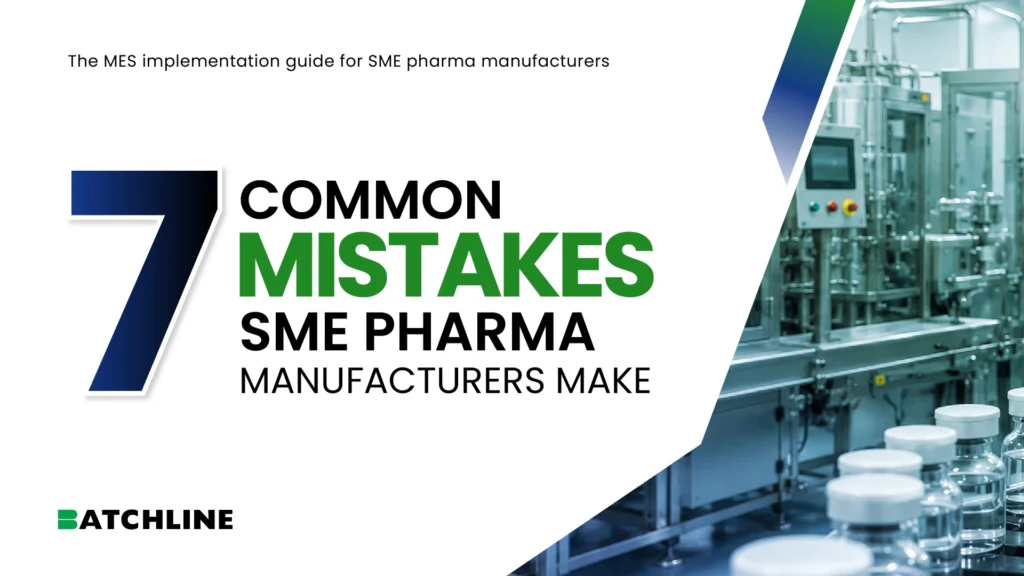
6. Seven mistakes’ SME pharma manufacturers make
Even the best MES can fail to deliver value if common implementation mistakes are overlooked. Here are seven pitfalls SME pharmaceutical manufacturers should avoid.
- Trying to digitise and connect everything at once
- Treating MES as an IT project
- Skipping or rushing the value identification and URS
- Underestimating change management
- Assuming the vendor can handle all validation
- Starting formal testing without a risk-based data integrity approach
- Not planning for ongoing validated operational state
7. Your MES readiness checklist
Use this checklist to ensure your MES implementation starts on the right foundation.
Foundation
- Clear business objectives and success metrics defined
- URS documented and aligned with project scope
- Master Batch Records documented and standardized
- Key SOPs are current and accessible
- Internal project owner assigned
- IT infrastructure supports a cloud-based MES
Compliance
- GMP and regulatory requirements identified
- CSV approach and responsibilities defined
- Data integrity requirements (ALCOA+, audit trails, access controls) understood
- Change control process established for post-go-live operations
People
- Production and QA teams engaged in the project
- User training planned for all roles
- Go-live support arranged from internal teams or implementation partner
8. The business impact of MES
Companies that implement MES often achieve measurable improvements in operational efficiency, compliance, product quality, and production performance.
| Company | Industry | Business Impact |
|---|---|---|
| Global Biotech Products (GBP), Thailand | Vaccine manufacturer | 60% faster production review, 50% faster QA review & approval, improved data integrity, and reduced manual data entry. |
| Cyto-Facto, Japan | Cell & Gene Therapy CDMO | 50% reduction in review time, 30% less effort handling paper-related issues, and 1 hour saved per batch through digital batch records. |
| Halo Pharma, Canada | Pharmaceutical CDMO managing 100+ molecules and 350+ batches annually | 2–3 days faster batch release, over 50% fewer documentation errors, and QA review reduced from 75 to 30 minutes per batch. |
| SCHOTT MINIFAB, Australia | Medical device manufacturer | 10–20% increase in operator efficiency, 30% faster product release, and successful go-live in just 11 weeks. |
9. BatchLine MES for life sciences manufacturing
BatchLine MES is a cloud-based MES designed for SME life sciences and pharmaceutical manufacturers. It helps companies digitise manufacturing with a solution that is affordable, fast to deploy, GMP-ready, and easy to manage.
- Purpose-built for regulated life sciences manufacturing
- Go live in as little as 4 months
- Supported by GMP and CSV expertise
- Flexible licensing and scalable deployment
- Simple enough for teams to operate independently
Whether you’re starting your digital manufacturing journey or planning an MES project, BatchLine provides a practical path to compliant and efficient operations.
🚀 Download
the full Manufacturing Execution System (MES) implementation guide
? FAQs
While often used together, MES and EBR serve different purposes.
An Electronic Batch Record (EBR) focuses on digitising batch documentation, guiding operators through manufacturing steps, capturing production data, and ensuring compliant batch records.
A Manufacturing Execution System (MES) provides broader control of manufacturing operations, including production workflows, materials, equipment, quality processes, and performance monitoring.
In simple terms, EBR is a core capability within MES, while MES delivers a wider range of operational, compliance, and business benefits across the manufacturing process.
Pharmaceutical manufacturers are implementing MES to improve operational efficiency, strengthen GMP compliance, reduce manual errors, and gain real-time visibility into manufacturing processes.
As regulatory expectations and production demands increase, MES provides the digital foundation needed to improve quality, accelerate batch release, and support future growth.
MES solutions generally fall into three categories, depending on their architecture and deployment approach:
- Traditional MES Large, highly customized systems that are typically deployed on-premise and require significant implementation effort.
- Cloud-Based MES Modern MES platforms such as BatchLine delivered through the cloud, offering faster deployment, lower infrastructure costs, and easier scalability.
- Composable MES Flexible, Composable MES solutions like Tulip, frontline operations platform that allow manufacturers to build and adapt applications quickly using low-code or no-code technologies.
For SME pharmaceutical manufacturers, cloud-based and composable MES solutions are often preferred due to their lower cost, faster implementation, and greater flexibility.
The best MES for SME pharmaceutical manufacturers should be practical, compliant, and easy to scale. When evaluating solutions, consider:
- Industry and GMP expertise
- Compliance and CSV readiness
- Ease of deployment and use
- Scalability for future growth
- Integration with existing systems
- Vendor implementation and support capabilities
Choose an MES that aligns with your business objectives and delivers measurable value.
Implementation timelines vary depending on scope and site readiness.
While traditional MES projects can take 12 months or more, a modern cloud-based MES like BatchLine can typically go live in as little as 4 months for SME pharmaceutical manufacturers.