Cloud-based Manufacturing Execution Systems (MES) are transforming pharmaceutical manufacturing by making digital records accessible, but the regulatory expectations remain the same.
To comply with international GMP requirements, manufacturers must demonstrate that their cloud MES is fit for its intended use, maintains data integrity, and consistently performs as expected.
This is the focus for Computer System Validation (CSV), that plays a critical role in MES deployments.
In this article
What is Computer System Validation (CSV)?
Computer System Validation (CSV) is the documented process of demonstrating that a GxP-regulated computerized system consistently performs as intended, and is capable of producing accurate, reliable, and compliant records throughout its lifecycle.
For Manufacturing Execution Systems (MES), validation provides objective evidence that the system supports Good Manufacturing Practice (GMP) requirements, maintains data integrity, and performs consistently and reliably under operating conditions.
It also ensures that electronic records and electronic signatures comply with regulations such as 21 CFR Part 11 and EU Annex 11.
Why CSV is essential for Cloud MES
Moving an MES to the cloud does not reduce regulatory expectations. If anything, validation becomes even more important because the regulated company relies on externally provided cloud services that sit at the heart of their manufacturing operations.
A modern cloud MES controls manufacturing workflows, enforces process parameters, captures Electronic Batch Records (EBR), manages production data, records operator actions, and provides the evidence Quality Assurance relies upon to review and release every batch. The integrity of this data directly impacts product quality, patient safety, and regulatory compliance.
Without appropriate validation, manufacturers face significant risks, including:
- Incorrect or inconsistent manufacturing processes.
- Data integrity failures that compromise electronic records.
- Regulatory observations related to GMP non-compliance.
- Delays in batch review and product release.
- Increased operational and business risk.
Cloud is allowed under GMP
Cloud technology is fully compatible with GMP requirements. The US FDA for example, has made it clear that regulations are intentionally flexible to encourage innovation, and allow manufacturers to adopt modern technologies including cloud computing, when they improve product quality and operational performance.
Cloud and Software-as-a-Service (SaaS) solutions are not exceptions to GMP requirements, and have been used widely in the regulated industry for over a decade.
Instead, they require manufacturers to adopt a validation approach that reflects shared responsibilities between the regulated company, its software provider and underlying cloud services.

Why traditional CSV doesn’t transfer to cloud MES
On-premise MES validation will mean mountains of pages of documentation for the server hardware alone, a typical deployment can comprise more than a dozen physical servers, and a long list of internal experts spending effort to check and document them. This is not a one-time cost, as server hardware and networking needs to be continuously maintained, updated and secured.
In a SaaS model, the user doesn’t own most of the infrastructure stack, so the traditional Installation Qualification concepts do not apply directly. Responsibilities must shift instead to be a formalized governance through SLAs and Quality Agreements that define exactly where the supplier’s scope ends and the user’s begins.
Modern suppliers also build software differently. Agile, not waterfall methods allow for faster and earlier development releases, specifications are managed in Agile terms such as epics and user stories, and rather than static documents, are ensured through automated document artifacts and automated exploratory testing.
The ISPE’s GAMP 5 Second Edition explicitly supports this shift to modern software practices. And since IQ/OQ/PQ was originally designed for equipment, not software, duplicating a qualified supplier’s testing adds cost without adding compliance value, a principle reinforced recently by the FDA’s Computer Software Assurance (CSA) initiative.
The core rule: responsibility is shared, accountability isn’t.
Regardless of how activities are divided between supplier and customer, the regulated manufacturer remains fully accountable for demonstrating GMP compliance to regulatory authorities.
A practical model: Qualification + Validation
Split the lifecycle into two tracks:
1. Supplier-side Qualification
2. User-side Validation
Functionality, infrastructure, configuration, and security, governed by the SaaS supplier’s QMS. Deliverables typically include a Qualification Plan, Requirements Traceability Matrix, risk-based testing (automated, scripted, and exploratory), and a Qualification Report confirming the system is fit for GxP use.
Intended use and master data, governed by the user’s QMS. This leverages supplier qualification evidence rather than re-testing it, focusing instead on configuration, interfacing devices, and operational SOPs (change control, EBR/MBR verification, access control, backup/recovery, audit trail review) all of which must stay compliant with 21 CFR Part 11 and EU Annex 11 throughout the system’s operational life.
Risk-based data integrity assessment
Scope testing by data source rather than treating every function equally. Using ALCOA+ principles (Attributable, Legible, Contemporaneous, Original, Accurate, plus Complete, Consistent, Enduring, Available), manually entered data carries higher vulnerability than system-generated or interfaced data. Mapping vulnerability against GxP criticality drives the test strategy: rigorous scripted testing for high-risk data, lighter unscripted testing for low-risk data.
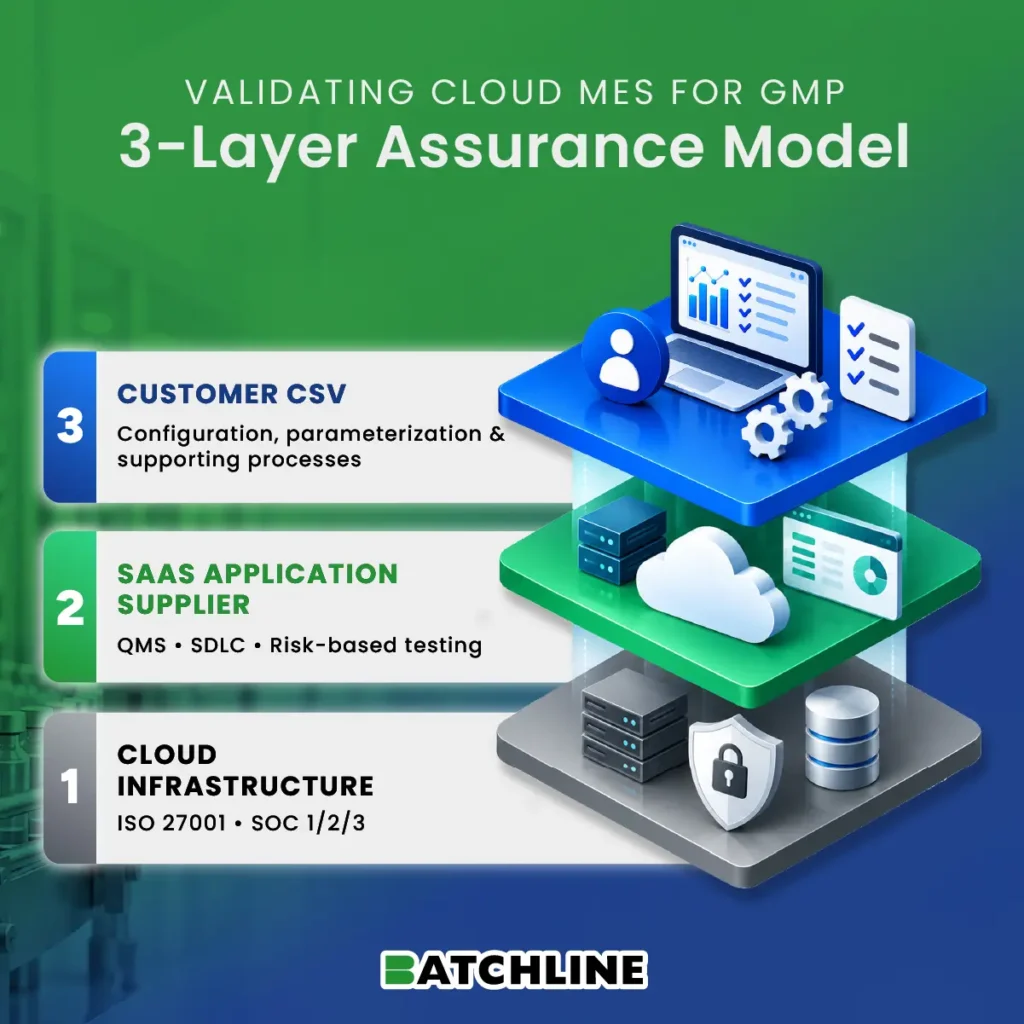
A three-layer assurance model
1. Cloud infrastructure provider independently audited and certified (e.g., ISO 27001, SOC 1/2/3).
2. SaaS application supplier own Quality Management System (QMS), Software Development Lifecycle (SDLC) documentation, and risk-based testing.
3. Customer CSV focused on configuration, parameterization, and supporting processes, not re-proving what’s already qualified upstream.
When assessing a cloud MES supplier, look for a documented QMS and SDLC, complete GxP qualification evidence, infrastructure platform controls, a defined release management process, and demonstrated security/backup-restore testing.
Conclusion
Cloud MES doesn’t require less validation rigor. It requires applying it differently and using critical thinking. Suppliers qualify functionality, infrastructure, and security through a risk-based SDLC; users validate intended use, configuration, and master data, leveraging supplier evidence instead of duplicating it. Accountability to the regulator always stays with the user.
Watch the full webinar
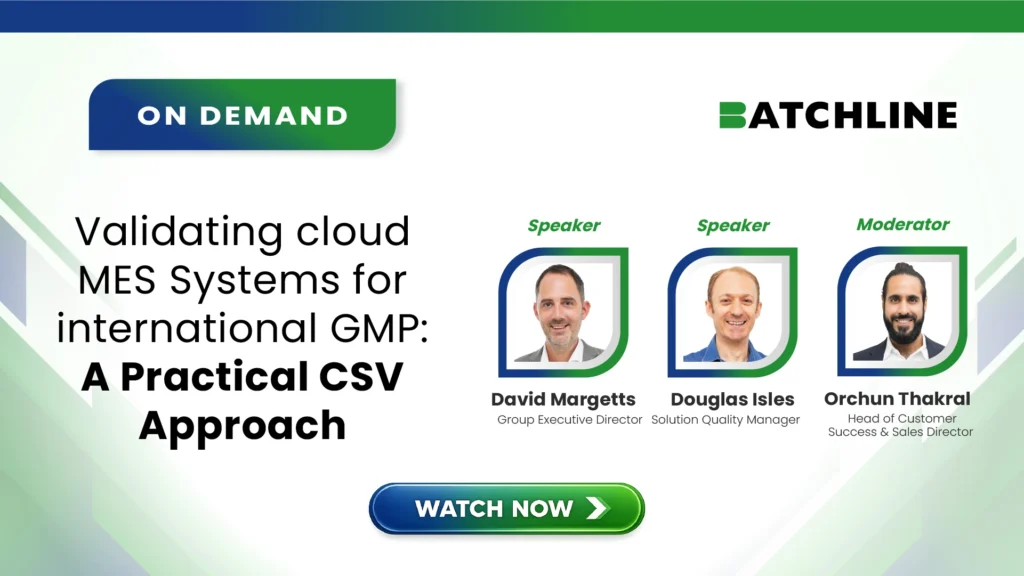
This article is based on our webinar, “Validating Cloud MES for International GMP: A Practical CSV Approach,” featuring BatchLine’s Orchun Thakral (Head of Customer Success & Sales Director), David Margetts (Group Executive Director), and Douglas Isles (Solution Quality Manager).
Watch the full session and a deeper walkthrough of the BatchLine validation strategy and real-world cloud MES example or get in touch with our team to discuss your own cloud MES validation approach.
FAQs
Yes — the FDA confirms CGMP rules permit modern technologies like cloud computing, provided validation responsibilities are clearly defined.
On-premise requires qualifying physical servers and infrastructure directly.
With cloud MES, infrastructure and application qualification shift to the supplier, while the user focuses on configuration, intended use, and operational processes.
Testing effort is scoped to GxP criticality and data vulnerability rigorous scripted testing for high-risk, manually entered data; lighter unscripted testing for low-risk, system-generated data. Aligns with the FDA’s CSA initiative.
A documented QMS and SDLC, GxP qualification evidence, infrastructure certifications (ISO 27001, SOC 1/2/3), a defined release process, and demonstrated security/backup testing.
The supplier typically qualifies the application and infrastructure; the user validates intended use and configuration but the user remains accountable to the regulator either way.
Yes, fully.
Cloud deployment doesn’t remove these requirements. It changes how compliance is demonstrated, through combined supplier qualification and user validation.