From paper to digital: A practical roadmap for GxP manufacturers
Life sciences manufacturers are under increasing pressure to improve efficiency, ensure data integrity, and maintain strict regulatory compliance.
Yet many pharmaceutical, biotech, and medical device companies still rely on paper-based batch records—creating risks such as manual errors, slow batch review, and limited visibility into production operations.
The Electronic Batch Record (EBR) Implementation Guide 2026 provides a practical roadmap for organisations looking to move from paper documentation to modern digital manufacturing.
Designed for production leaders, QA/QC teams, digital transformation and operational excellence leaders, IT and automation specialists, and regulatory professionals, this guide explains how manufacturers can successfully implement EBR systems in real GxP environments.
Inside the guide, you will learn:
The guide is particularly relevant for organisations in pharmaceutical, biotechnology, cell and gene therapy, medical devices, and other regulated manufacturing industries.
Download the full guide to learn how successful manufacturers implement EBR and digital GxP manufacturing.
1. What is an Electronic Batch Record (EBR)?
An Electronic Batch Record (EBR) is a digital system that replaces traditional paper batch records used in GxP manufacturing.
Instead of recording production information manually, operators and quality teams execute and document manufacturing steps electronically within a controlled system.
An EBR system typically:
- Captures production data digitally in real time
- Guides operators through structured manufacturing workflows
- Enforces GMP-compliant processes with electronic signatures and audit trails
- Integrates with systems such as ERP, LIMS, and equipment data sources
- Supports batch review, approval, and regulatory inspection readiness
By digitising batch execution, EBR systems improve data accuracy, traceability, and manufacturing visibility across the organisation.
2. Why is EBR foundational in 2026?
In 2026, EBR is no longer just a technology upgrade. It has become a foundation for modern GxP manufacturing.
Several industry forces are driving adoption:
Rising regulatory expectations
Global regulators increasingly expect manufacturers to maintain complete, traceable, and reliable production records. Paper systems make it difficult to demonstrate data integrity and respond quickly during inspections.
Faster batch release requirements
Manufacturers must reduce review times while maintaining quality. EBR enables review-by-exception and faster batch release cycles.
Workforce and knowledge challenges
As experienced staff retire and new digital-native workers join the workforce, companies must standardise manufacturing procedures and reduce reliance on manual knowledge transfer.
Digital transformation and Pharma 4.0
EBR provides the structured production data needed for analytics, automation, and AI-driven manufacturing improvements.
Cost and risk management
EBR helps reduce compliance risk, prevent costly documentation errors and batch failures, and free up production and QA resources for higher-value activities.
3. What are the benefits of Electronic Batch Records (EBR)?
By replacing paper documentation with digital workflows, EBR provides several practical benefits for GMP manufacturers:
- Improved data integrity through audit trails, electronic signatures, and controlled workflows
- Faster batch review and release through automated checks and review-by-exception
- Reduced human errors through guided workflows and built-in validations
- Better visibility into manufacturing operations with real-time production data
- Improved traceability across the full batch lifecycle
- Stronger regulatory compliance with global GMP and data integrity requirements
- Lower operational risk and cost by reducing manual documentation and investigation time
Overall, EBR enables manufacturers to move toward more efficient, compliant, and data-driven manufacturing operations.
4. Key industry trends in EBR implementation
EBR implementations are evolving rapidly. The guide explains several key trends shaping the industry in 2026:
No-code / low-code configuration
Modern platforms allow process owners to configure batch records and workflows without heavy custom coding.
Data integrity and ALCOA+ by design
EBR systems embed ALCOA+ data integrity principles, ensuring traceable and reliable production records.
Integrated digital manufacturing ecosystems
Manufacturers increasingly connect EBR with:
- ERP systems for production planning
- LIMS for laboratory testing results
- Equipment and IoT devices for automated data capture
Cloud-based and scalable platforms
New EBR systems are delivered as cloud-based SaaS platforms, simplifying upgrades and validation management.
Improved user experience (UX) for shop-floor teams
Modern interfaces reduce training time and improve adoption by production operators.
Fit-for-purpose digitalisation for smaller manufacturers
Smaller companies such as emerging biotech / vaccine manufacturers are adopting lighter, more affordable EBR solutions with shorter implementation timelines.
These trends allow companies to implement EBR faster and with lower complexity than traditional MES projects.
5. Understanding digital maturity in manufacturing
Successful EBR implementation begins with understanding where your organisation currently sits on the digital maturity journey.
Most manufacturers fall into one of three stages:
|
Stage 1: Paper-based operations |
Stage 2: Hybrid digital environment |
Stage 3: Fully digital manufacturing |
|---|---|---|
|
• Manual documentation • Limited data visibility • High risk of transcription errors • Slow batch review processes |
• Some digital systems but still reliant on paper • Data scattered across multiple platforms • Duplicate data entry and fragmented workflows |
• Electronic batch records and integrated MES systems • Automated workflows and data capture • Real-time production visibility • Faster review and release cycles |
Moving from paper to fully digital operations requires alignment across people, processes, and technology.
6. Common misconceptions about EBR
Many organisations delay digital transformation due to misunderstandings about EBR implementation.
Common misconceptions include:
- “EBR is just digitising paper (PDFs, scanned forms, e-signatures).”
- “We must connect every system before starting.”
- “We must implement full MES not only EBR.”
- “Paper is safer for compliance than digital.”
- “Technology is the hard part; process and culture will follow.”
- “Vendor document packages are all we need to be ‘validated’.”
In reality, successful companies often start with a focused EBR implementation, deliver quick operational value, and expand their digital capabilities gradually.
7. A practical checklist for selecting the right EBR vendor
Selecting the right EBR platform is one of the most important decisions in digital manufacturing transformation.
The guide includes a vendor selection checklist covering:
1️⃣ Define your user requirements and targeted benefits
2️⃣ Evaluate the supplier’s capability
3️⃣ Ensure the solution supports future growth
4️⃣ Try the system before you commit
5️⃣ Assess ease of implementation
A structured evaluation helps ensure that the system supports long-term operational and compliance requirements.
8. Practical EBR implementation methodology
Successful EBR implementation requires more than installing software. It requires a structured deployment approach aligned with GMP requirements.
The guide explains a five-phase implementation model:
1️⃣ Discovery and site assessment
2️⃣ Solution design
3️⃣ Build and configuration
4️⃣ Validation and testing
5️⃣ Training and go-live
Many companies start with a pilot process or product line, then scale across the organisation once value is proven.
9. Integrations and connected digital manufacturing
Modern EBR systems act as the data backbone of digital manufacturing.
Typical integrations include:
- ERP systems for production orders and materials
- LIMS for laboratory testing results
- Equipment and sensors for automated data capture
- Quality systems and document management platforms
Together, these integrations create a connected digital manufacturing ecosystem aligned with Pharma 4.0 principles, improving visibility, efficiency, and operational control across the organisation.
A modern and effective way to enable device and machine connectivity is through IoT-based architectures using publish/subscribe communication models, such as the MQTT protocol.
MQTT is a lightweight messaging protocol that allows data to be transmitted securely and efficiently from the shop floor to higher-level systems of record, enabling reliable real-time communication across manufacturing environments.
10. Real-world results from EBR implementation
Companies implementing EBR often see measurable operational improvements.
For example:

SCHOTT MINIFAB
After implementing BatchLine EBR, the organisation achieved:
- 10–20% improvement in operator efficiency
- 30% faster product release time
- Elimination of manual completeness checks and paper documentation
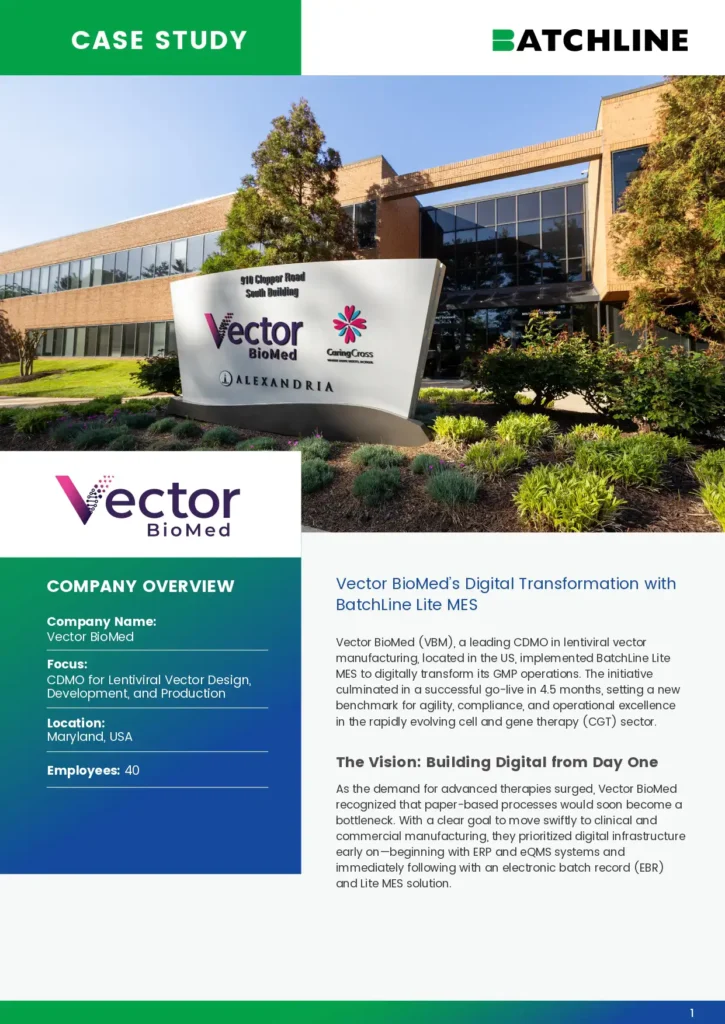
Vector BioMed
The CDMO implemented BatchLine EBR to support cell and gene therapy manufacturing and completed system implementation and validation in approximately 4.5 months.
Across the industry, EBR implementations typically deliver:
- 30–80% faster batch review and release
- Reduced documentation errors
- Lower compliance risk
- Elimination of paper management costs
11. BatchLine MES for modern life sciences manufacturing
BatchLine MES is designed specifically for GxP-regulated manufacturing environments including pharmaceuticals, biotech, cell and genes therapies, and medical devices.
The platform enables manufacturers to:
- Digitise batch execution with Electronic Batch Records
- Capture production data automatically
- Improve shop-floor visibility
- Accelerate batch review and release
- Integrate manufacturing systems into a connected digital ecosystem
BatchLine focuses on fast, practical implementation, allowing organisations to start with a targeted scope and expand their digital capabilities over time.
🌟 Download the full EBR implementation guide
This page provides a high-level overview of EBR implementation in modern life sciences manufacturing.
The full guide includes detailed frameworks, readiness checklists, vendor selection tools, and implementation strategies designed for GMP-regulated organisations.
? FAQs
An Electronic Batch Record (EBR) system is a software platform used to create, manage, and review digital batch records in GMP-regulated manufacturing.
It guides operators through production steps, captures manufacturing data in real time, and helps ensure compliance, traceability, and faster batch review.
EBR systems are commonly implemented as part of Manufacturing Execution Systems (MES) or specialised digital manufacturing platforms.
In MES vs EBR, a Manufacturing Execution System (MES) manages and coordinates overall manufacturing operations such as production workflows, equipment monitoring, quality control, and material tracking.
In contrast, an Electronic Batch Record (EBR) focuses specifically on digitizing batch documentation, guiding operators through batch steps, capturing production data, and ensuring compliant batch records.
Companies implement EBR to improve compliance, reduce documentation errors, accelerate batch release, and enable digital GxP manufacturing strategies.
Implementation timelines vary depending on scope. Many modern EBR projects can be implemented in several months, particularly when companies start with a pilot process before scaling.
EBR commonly integrates with:
- ERP systems
- LIMS / QC systems
- Production equipment
- Document management systems
- Quality management systems
These integrations create a connected digital manufacturing environment.