Waiting no longer reduces risk; it increases it.
In this article
About the Japanese Pharmaceutical Market
How would you describe the current state of digital transformation in Japan’s pharmaceutical manufacturing industry?
Japan’s pharmaceutical industry is at a turning point. Manufacturers are recognized worldwide for exceptional quality, yet much of that excellence still depends on paper records and manual verification.
Having worked in pharmaceutical manufacturing IT for over 40 years – from mainframe systems to global MES rollouts and, more recently, Cell Therapy manufacturing environments – I can say the awareness of digital transformation is now very high, but actual adoption still lags. By our estimate, around 85% of Japanese manufacturing sites still rely heavily on paper and Excel, and Japan is roughly 5 to 10 years behind Europe and North America in GMP-compliant computerized systems. The intent is clear; implementation is just beginning. That gap is precisely where the opportunity lies.
What are the biggest operational challenges Japanese pharmaceutical manufacturers are facing today?
Three challenges stand out.
First, an aging and shrinking workforce, which makes it hard to sustain quality that has historically depended on experienced people.
Second, the heavy burden of paper-based documentation and manual review, which slows batch release and consumes skilled staff.
Third, rising pressure for data integrity and regulatory compliance, from both Japanese authorities and global partners.
These are especially acute in emerging fields such as Cell and Gene Therapy, where processes are complex and traceability demands are high, yet many sites are still at the paper-and-Excel stage.
Why is now the right time for Japanese manufacturers to digitize batch manufacturing?
Several forces are converging. The workforce challenge means companies can no longer rely solely on manual, experience-based operations.
Expectations for data integrity have risen sharply. New modalities such as Cell and Gene Therapy demand far tighter, more traceable control than traditional processes.
At the same time, technology itself has matured – cloud-based MES and electronic batch records are now far more accessible and flexible, and AI is beginning to transform how manufacturing data is captured and used.
Waiting no longer reduces risk; it increases it. Now is the moment to act, while proven and affordable solutions are finally available.
Compared with five years ago, how have customer expectations changed regarding MES and digital manufacturing?
Five years ago, manufacturers saw MES as a large, complex, expensive IT project. Today, expectations have shifted decisively toward flexibility, faster time-to-value, and lower total cost.
When a full conventional stack – infrastructure, ERP, MES, LIMS, scheduler, and interfaces – can exceed one billion yen, manufacturers rightly ask whether there is a better way.
They now expect solutions that start small and scale, adapt to existing processes rather than forcing a redesign, and integrate cleanly with other systems.
There is also far greater attention to local-language support and to partners who understand Japanese regulatory practice, including the shift from CSV to a risk-based assurance approach (CSA: Computer Software Assurance).
Expectations have become more practical and more demanding at once.
What trends do you expect to shape the Japanese life sciences manufacturing industry over the next 3–5 years?
I expect four trends.
First, steady acceleration of MES and paperless manufacturing as pilot projects prove their value.
Second, rapid growth of Cell and Gene Therapy and other advanced modalities, which require highly traceable, flexible systems.
Third, a shift from fragmented, individually optimized systems toward integrated cloud platforms, connected through middleware and Industrial DataOps rather than rigid point-to-point interfaces.
And fourth, the most transformative, the arrival of AI as a native part of manufacturing: automating data capture, generating batch records, detecting deviations in real time, and supporting a Quality-by-Design approach across the whole process.
The combination of an integrated cloud platform and AI is what will reshape this industry.

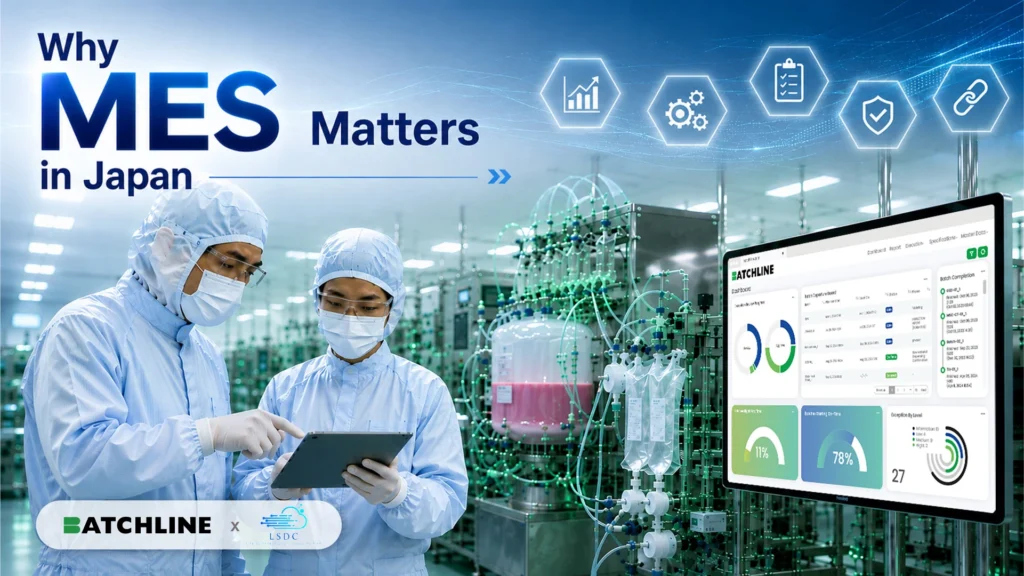
Why MES Matters in Japan
Why are more Japanese pharmaceutical companies considering Manufacturing Execution system (MES) today?
The main driver is the combination of workforce pressure and rising compliance expectations. As experienced operators retire, companies need systems that capture and enforce process knowledge rather than relying on individuals.
MES makes operations repeatable, reduces human error, and produces reliable electronic records that satisfy data-integrity requirements – and it speeds up batch release by moving review from paper to electronic records.
For newer modalities such as Cell and Gene Therapy, traceability itself becomes a primary reason to adopt. Increasingly, manufacturers also see MES not as an end point but as the foundation for AI-enabled manufacturing in the years ahead.
What are the main business drivers behind MES projects in Japan?
The strongest drivers are efficiency and compliance. On efficiency, manufacturers want to cut the time and labor spent on documentation and review – in a typical Cell-Therapy operation this can mean tens of thousands of staff-hours and vast quantities of paper each year.
On compliance, they want assured data integrity and audit-readiness for both domestic inspections and global partners.
A third driver, growing in importance, is workforce sustainability: capturing operational know-how in the system so quality no longer depends on a shrinking pool of experts.
What are the biggest barriers and concerns Japanese manufacturers have before investing in an MES?
The biggest barriers are the perceived cost and risk of implementation.
Many Japanese manufacturers—especially mid-sized companies and emerging Cell and Gene Therapy facilities—worry that an MES project will be expensive, disrupt proven production processes, and require significant validation and change-control effort.
When conventional MES platforms can cost hundreds of millions of yen per site and more than a billion yen over the lifetime of a program, hesitation is understandable.
There are also concerns about whether the vendor and its local partner can provide Japanese-language support and understand local regulatory expectations.
This is why right-sized, cloud-based MES solutions are gaining traction in Japan. By lowering the upfront investment, adapting to existing processes, and providing strong local implementation support, manufacturers can start with a manageable scope and expand over time with confidence.
What common misconceptions do customers have about MES implementation? have before investing in an MES?
The most frequent misconception is that MES must be an enormous, all-or-nothing project that takes years and reshapes the entire operation.
In reality, a well-chosen cloud MES can be introduced incrementally, starting with the highest-value processes and expanding over time.
Another misconception is that MES forces a company to abandon its existing ways of working; a flexible solution should adapt to established processes, not the reverse.
And many assume integration with ERP and other systems is prohibitively difficult, when modern middleware and DataOps approaches make it far more manageable than before.
A further point specific to Cell and Gene Therapy:
Simply having installed an EBR does not mean it works – in Japan, more than half of sites that adopted EBR find it does not perform as expected, which is why re-designable, execution-based systems are so important.
Why LSDC Selected BatchLine
What led LSDC to partner with BatchLine?
My background shaped this decision. Over four decades I led MES, ERP, quality, and validation projects at a global pharmaceutical company, then built a GMP-compliant IT environment for Cell-Therapy manufacturing at Kobe’s medical industry cluster, and later led development of a cloud manufacturing system for cell production.
That experience taught me exactly what Japanese manufacturers need: flexibility, a reasonable cost structure, strong data integrity, and the ability to scale from a focused start. BatchLine matched these criteria as a process-driven, cloud-based electronic batch record and MES platform.
Just as important, we found in BatchLine a partner genuinely committed to Japan and open to close collaboration on localization, documentation, and joint market development. The right technology and the right relationship together led us to commit as an Authorized BatchLine VAR Partner.
What differentiates BatchLine from other MES solutions available in Japan?
BatchLine stands out with its flexible, cloud-based architecture and cost-effective SaaS model. As a cloud service, it removes the need for customers to build and run their own infrastructure or maintain large IT teams — a decisive advantage in Japan, where IT resources are scarce.
It adapts to existing manufacturing processes without requiring major redesigns and can start at a manageable scope, scaling as needs grow. This makes it well suited to starting and/or small and mid-sized pharmaceutical companies and fast-growing Cell and Gene Therapy manufacturers, for whom oversized, high-cost platforms are a poor fit.
With LSDC’s local implementation expertise, Japanese-language support, and regulatory knowledge, BatchLine offers a practical path to digital manufacturing — and a foundation on which to build AI-enabled capabilities.
A further differentiator is BatchLine’s ability to capture the entire QC testing process, not just the final result, as part of the electronic batch record.
In Cell Therapy, testing is an extension of manufacturing: the same culture conditions that shape the product also shape the test, so a bare result value cannot explain how it was reached.
By recording the test as structured, batch-linked fact — sampling, measurement conditions, operation sequence, and raw data before any pass/fail judgment — BatchLine lets you place the testing record beside the manufacturing record of the same batch.
When a result is unexpected, you can determine on facts whether the cause lies in the product or in the test itself, link it directly to CAPA, and give inspectors a coherent, process-level explanation. This is precisely what general, results-oriented LIMS struggle to provide, and it is central to BatchLine’s value in Cell and Gene Therapy manufacturing.

Japanese Customer Requirements
Are there any unique requirements from Japanese pharmaceutical manufacturers that differ from other markets?
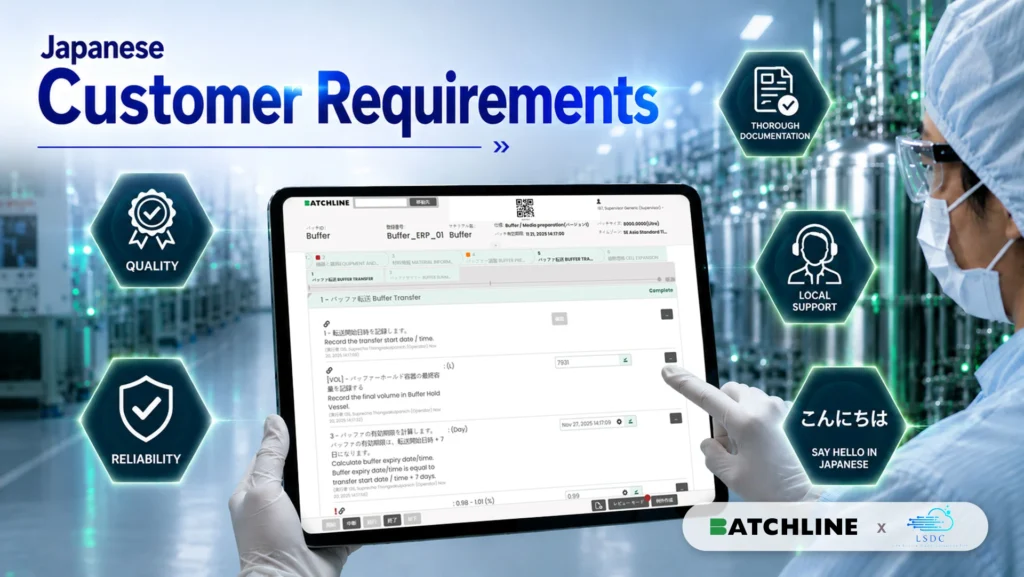
Yes. Japanese manufacturers place exceptionally high value on quality, reliability, and thorough documentation, and expect vendors and partners to match that standard.
Local-language support is not optional – materials, interfaces, and support in Japanese are essential for adoption.
There is a strong preference for careful, low-risk implementation that does not disrupt proven processes, and for partners who understand Japanese regulatory expectations in detail, including the ongoing transition from CSV to CSA.
Relationships and long-term trust carry more weight in purchasing decisions here than in many other markets. Meeting these expectations requires a strong local partner, not just a good product.
Implementation Experience
Based on your experience, what advice would you give companies starting their MES and digital manufacturing journey, and what factors are critical for success?
Successful MES implementation starts with a clear business objective and a manageable first step, rather than trying to digitize everything at once. Focus on high-value processes first.
Involve operators and quality teams from the beginning so the system reflects real operations rather than an idealized version of them. Build validation, data integrity, and integration with existing systems such as ERP and LIMS into the project from day one. This creates a solid foundation for long-term success.
Most importantly, choose a solution and a partner that can grow with your business. Early success should become the foundation for continuous digital transformation, not the end of the journey.
In Japan, local implementation support is especially important. Many manufacturers have limited in-house IT resources, so the right partner should be able to guide the project, bridge language and regulatory requirements, and reduce the burden on the customer.
Digital transformation is a journey, and steady, well-supported progress is far more effective than an ambitious project that overwhelms the organization.
This is supported by industry research. BCG found that around 70% of digital transformation initiatives fall short of their objectives, while McKinsey reported that in highly regulated industries such as pharmaceuticals, only 4–11% achieve sustained success.
In my experience, these challenges are rarely caused by the technology itself. Success depends on having the right implementation approach, strong user adoption, and an experienced partner who understands both the business and regulatory environment.

Looking Ahead
How do you see the partnership between LSDC and BatchLine supporting Japanese manufacturers in the future?
I see the partnership as a long-term bridge between world-class technology and the specific needs of Japanese manufacturers. LSDC brings local expertise – Japanese-language support, validation and regulatory knowledge, and hands-on implementation – while BatchLine provides a flexible, cost-effective cloud platform.
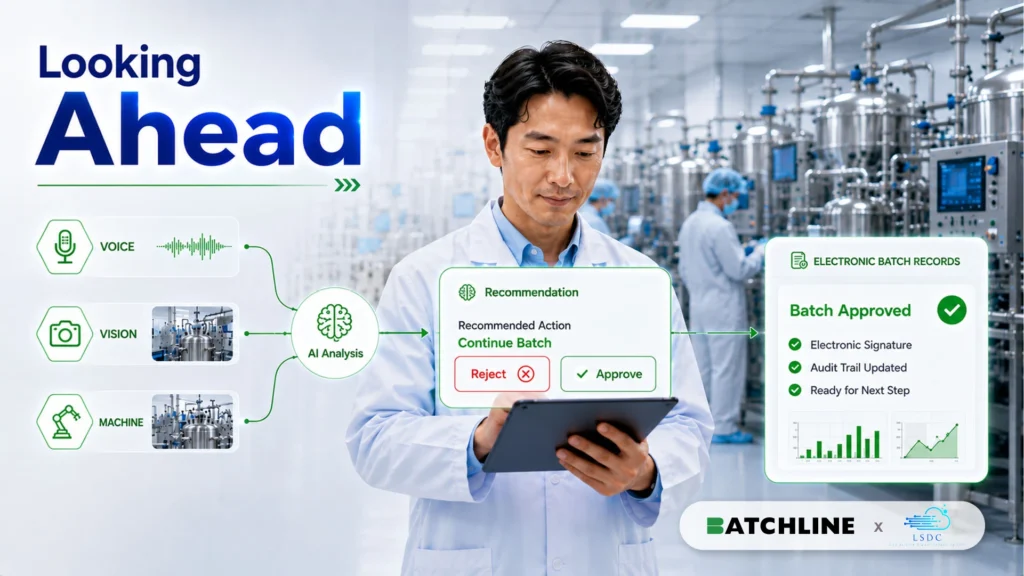
But our ambition goes further. We are focused on combining BatchLine with AI to computerize an ecosystem that supports Quality by Design across biopharmaceutical and Cell & Gene Therapy manufacturing – automating data capture from equipment displays, accepting voice input, recognizing images, and turning frontline data into structured records automatically, generating batch records, optimizing scheduling, and detecting deviations in real time, with AI proposing and people deciding.
This matters because a large share of Japanese manufacturers still record data by hand. We are building this through project-based collaboration with specialized AI companies in Japan and Taiwan – including EQUES and CarbGeM in Japan, and Therapi AI and AHEAD in Taiwan – each contributing capabilities such as automated data capture, generative process optimization, and manufacturing data analysis.
This work is reinforced by our industry-academia collaboration with Kobe University, where I serve as a Visiting Associate Professor, helping connect frontline manufacturing needs with advanced research. Our goal is to make advanced, AI-enabled manufacturing genuinely accessible to Japanese companies.
What opportunities do you see for BatchLine in the Japanese market over the next few years?
The opportunity is significant, driven by four key trends in the Japanese market:
1. Growing demand for paperless manufacturing.
Many Japanese manufacturers are ready to move beyond paper but have been waiting for a solution that is flexible and appropriately priced for organizations of their size—an area where BatchLine has a clear advantage.
2. Expansion of Cell & Gene Therapy (CGT) and other advanced modalities.
As these sectors continue to grow, manufacturers increasingly need electronic batch record (EBR) systems that can adapt quickly to evolving processes while maintaining full traceability.
3. A wave of first-generation EBR replacements and redesigns.
Many manufacturers that implemented early EBR platforms now find that their systems no longer reflect actual manufacturing workflows or support newer production processes, creating demand for more flexible next-generation solutions.
4. Accelerating adoption among mid-sized manufacturers.
As more early digitalization projects demonstrate measurable value, and AI-enabled capabilities become available as an added layer, adoption is expected to accelerate—particularly among mid-sized manufacturers seeking practical, scalable digital solutions.
Cost-effective supporting tools for inventory control, kitting, and material management will further lower the barrier, allowing smaller and emerging manufacturers to complete the picture affordably.
With strong local partnerships and customer support, BatchLine is well positioned to become a leading choice for Japanese manufacturers taking their first serious step toward digital manufacturing and, ultimately, AI-driven operations.
LSDC, an Authorised BatchLine Value Added Reseller, supports manufacturers across the region in implementing compliant EBR solutions and accelerating digital manufacturing.
Contact: info@lifedigicon.com