Digitization is no longer optional in the life sciences industry. Whether you’re a pharmaceutical manufacturer, a CDMO, or a biotech startup, selecting the right Electronic Batch Record (EBR) system is one of the most important decisions you’ll make on your digital journey.
The challenge?
There are many vendors, each claiming strong capabilities — but not all systems are built equally, especially when it comes to regulatory compliance, operational efficiency, and long-term scalability.
To help you evaluate effectively, here is a simple, practical checklist of key questions to ask before choosing your EBR system.
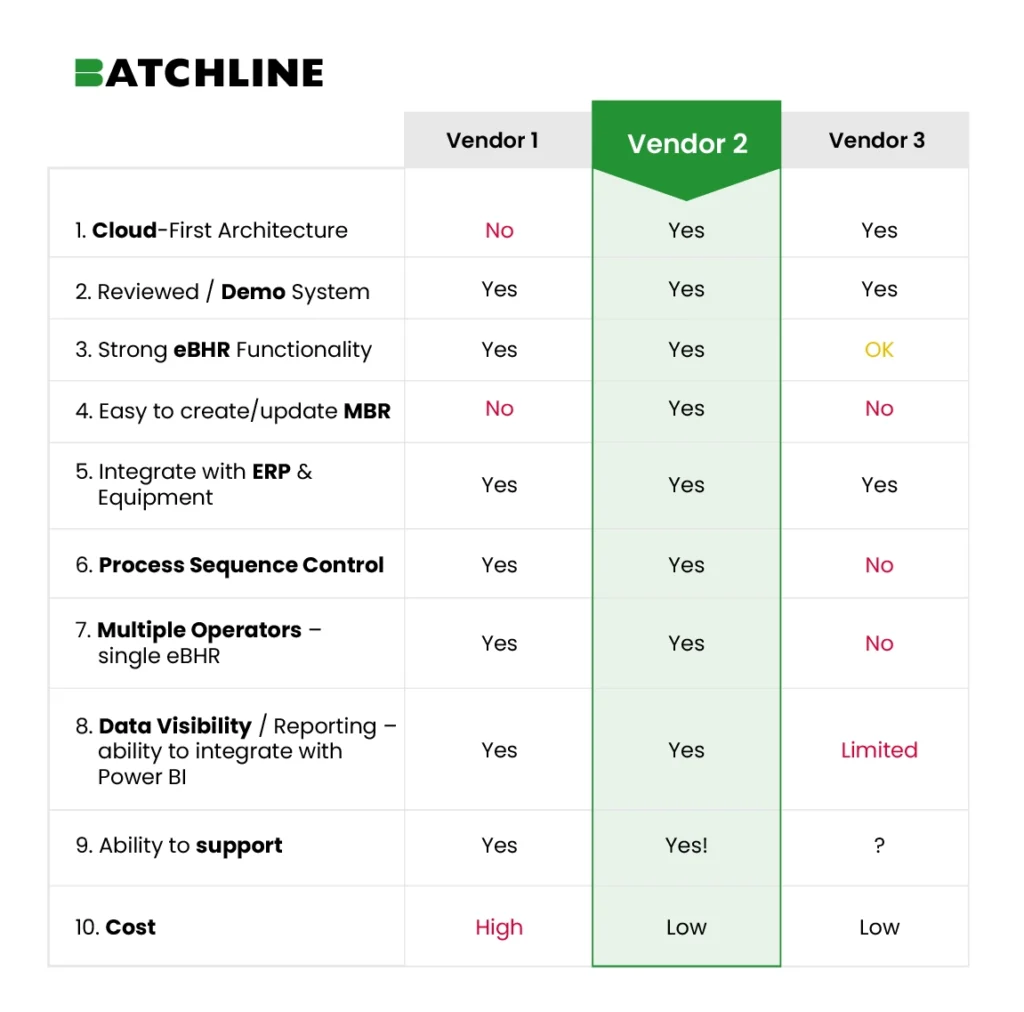
These questions are based on what customers consistently look for during MES/EBR evaluation, including insights from the comparison snapshot provided.
1. Is the System Built on Modern, Cloud-First Architecture?
Why it matters:
Legacy on-premise MES/EBR systems are rigid, costly, and slow to upgrade.
In contrast, cloud-native systems provide faster deployments, higher flexibility, automatic updates, improved security, and lower total cost of ownership.
What to look for:
- True SaaS delivery model (not on-prem software installed on cloud hosted servers – doesn’t provide the same benefits)
- Zero or minimal customer-managed infrastructure, installations, and upgrades.
- Easy scalability as production volume grows

Key question to ask vendors:
“Is your EBR platform cloud-native, or is it an on-premise system deployed in the cloud?”
A cloud-first architecture is now considered best practice for modern digitization programs.
2. Has the vendor provided a real system demo, or only slides/curated content?
Why it matters:
Seeing is believing. A vendor who can only talk about features — not demonstrate them — may not have a mature solution.
Ask yourself:
- Have we seen the system in action?
- Was the demo relevant to our processes, or generic and scripted?
- Did the team show transparency during the walkthrough?
What good looks like:
All shortlisted vendors should provide a fully demoed system, allowing your team to validate usability, workflows, and compliance controls.
3. Does the system offer strong eDHR/EBR functionality?
Why it matters:
Your EBR system should be built for regulated environments, not retrofitted from a generic manufacturing tool.
Evaluate:
- Does it handle exceptions, deviations, and inline QA reviews?
- Are workflows configurable and sequence controlled without heavy customization?
- Does it support cGMP, FDA 21 CFR Part 11, EU Annex 11, and ALCOA+ principles?
🚨 Red flags:
Limited capabilities often lead to hidden costs and long implementation times.
4. Is it easy enough to create and update MBR’s, processes, and specifications so you have the option to do it yourselves?
Why it matters:
One of the largest hidden costs with MES can be dependence on outsourced services to roll-out and update processes and products.
This can block roll-out and changes meet to new production needs limiting utilization and value.
Evaluate:
- How complex and labor intensive is the configuration work
- Is it feasible to develop and maintain skilled resources in-house
🚨Red flags:
Custom coding or complex no/low-code configuration that doesn’t feel realistic to internalise skills and maintain.
5. Can the system integrate seamlessly with ERP system and Equipment?
Why it matters:
Manufacturing data is only as strong as its connectivity. Without integration, companies end up re-typing data — a major data integrity risk. This is one of the biggest differentiators in 2026.
To enable a connected manufacturing environment, your EBR must integrate seamlessly with ERP systems, equipment, IoT devices, and analytics platforms — using modern, future-proof technology.
REST API and MQTT are now industry standards for interoperability — replacing outdated file-transfer or custom protocol approaches.
Key considerations:
- Standard connectors for SAP, Oracle, and common ERP systems
- Ability to integrate with scales, sensors, and production equipment
- Real-time data capture to avoid manual transcription errors
Ask the vendor directly:
- Do you support REST APIs for secure, real-time data exchange?
- Do you support MQTT for lightweight, high-frequency equipment connectivity?
- Do you provide pre-built connectors for SAP, Oracle, and common ERPs?
- Can we easily extract data into BI tools like Power BI?
👀 Look for:
Vendors with proven track records integrating with both ERP systems and shop-floor devices.
A modern EBR must behave like a digital platform, not a closed system.
6. Does the platform support Process Sequence Control?
Why it matters:
Process sequence control ensures operators follow the exact approved procedure — no skipping steps, no incorrect order, no guesswork
This directly supports:
- Right-first-time execution
- Audit readiness
- Reduced deviation rates
Ask:
- Can the system enforce mandatory steps?
- Can it guide operators dynamically based on process logic?
- Are alerts or holds triggered for out-of-sequence execution?
7. Can multiple operators work on a Single eDHR / EBR?
Why it matters:
Modern pharma operations are collaborative. Some EBR systems still limit access to one operator at a time, slowing production and risking delays.
A strong EBR should:
- Allow multiple operators to work in parallel
- Enforce proper login, timestamps, and accountability
- Maintain clear audit trails even with multiple contributors
This feature greatly improves throughput, especially in high-volume environments.
8. Does the system provide strong data visibility and reporting?
Why it matters:
Decision-making today depends on real-time, accessible data.
You need to evaluate:
- Are dashboards and reports included?
- Does it integrate with tools like Power BI?
- Is data export easy, accurate, and validated?
Limited reporting capabilities will bottleneck your quality investigations, trend analysis, and overall operational performance.
9. How strong is the Vendor’s Support Capability?
Why it matters:
Digitization is not a one-time event — you need long-term partnership.
Evaluate support quality:
- Responsiveness and regional presence
- Knowledge of life sciences and regulatory demands
- Ability to support upgrades, integration, and scaling
Some vendors stand out by providing high-touch, proactive support, while others offer minimal or unclear assistance.
10. What is the total cost — and does it align with value?
Why it matters:
Cost alone shouldn’t make the decision — but it matters. Some vendors come with high upfront fees, long validation timelines, or expensive customization requirements.
When comparing “High” vs. “Low” cost vendors, balance price with:
- Functionality maturity
- Implementation time
- Scalability
- Support quality
- Integration strength
Sometimes “low cost” solutions end up costly due to hidden limitations.
Final Thoughts:
Choosing the Right EBR Vendor
A modern EBR system should help you achieve:
- Right-first-time manufacturing
- Consistent compliance with ALCOA+ principles
- Improved visibility and traceability
- Fewer deviations and faster investigations
- Stronger quality culture across teams
Using the checklist above, your evaluation team can cut through marketing noise and focus on what really matters: a system that genuinely improves quality, accuracy, and operational efficiency.
Recommended Option:
BatchLine MES
Among modern EBR solutions, BatchLine MES stands out as a purpose-built solution crafted by GxP digitalization experts specifically for life sciences manufacturing.
It combines everything manufacturers look for in an EBR:
- Seamless ERP and equipment connectivity
- Review-by-exception workflows and real-time data capture
- Intuitive, validated templates for rapid deployment
- Role-based access control and full audit traceability
- Scalable architecture for single or multi-site operations
Its ready-to-validate design enables a smooth transition from paper to digital with minimal disruption— accelerating ROI while keeping implementation costs affordable and ensuring data integrity and compliance at every step.
Ready to Find the Right Fit?
Explore how BatchLine MES can power your digital manufacturing journey.