What's Inside
Why BatchLine MES leads the market
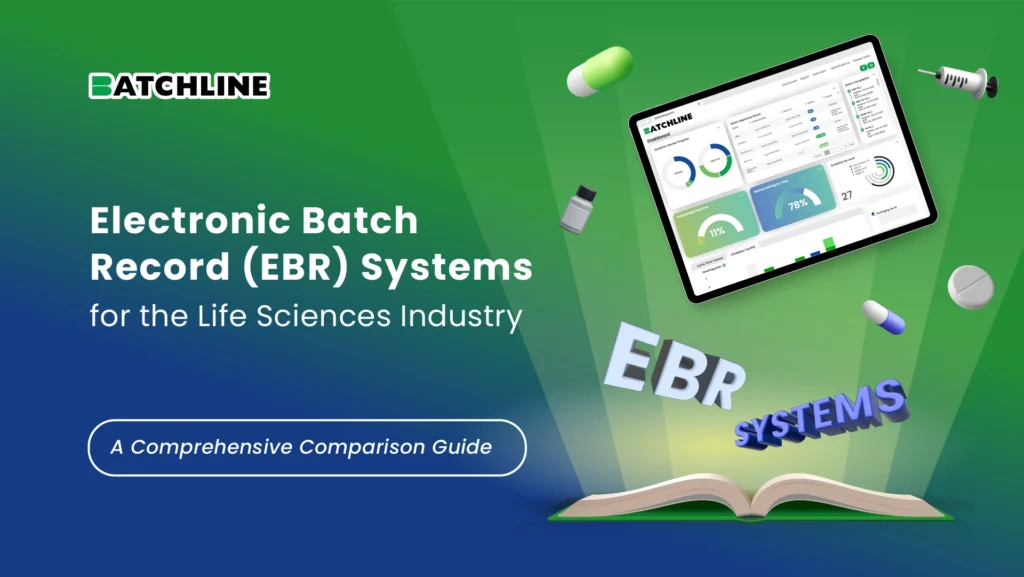
In the high-stakes world of pharmaceutical and biotech manufacturing, the transition from paper to Electronic Batch Record (EBR) is no longer optional—it is a regulatory necessity.
However, many teams struggle with the “Complexity Gap” of traditional MES platforms.
BatchLine bridges this gap by offering a modern Manufacturing Execution System (MES) with EBR approach: providing the robust GxP compliance of a tier-one system with the agility, affordability, and user-friendly GUI (Graphical User Interface) of a modern SaaS application.
Key differentiators that elevate BatchLine MES in modern life sciences manufacturing
BatchLine MES is engineered to give life sciences manufacturers the core capabilities they need from an EBR — without the heavy cost, complexity, or years-long implementation typically associated with MES platforms.
Unlike generic EBR modules, BatchLine is purpose-built for GxP batch execution, designed by experts who understand the operational realities of pharma, biotech, medical devices, and cell & gene therapy environments.
1. A configuration-first framework that reduces customisation risk
Traditional MES/EBR platforms often require heavy bespoke coding, leading to “Validation Fatigue.” BatchLine uses a configuration-first model, allowing teams to adapt processes without coding or large technical teams.
What this enables:
- Accelerate design:
Build Master Batch Records (MBRs) using intuitive, reusable components.
- Reduce validation burden:
Minimise “configuration drift” across different production sites.
- Self-sufficiency:
Empower your internal production teams to manage the system, reducing vendor dependency.
This approach ensures that digital batch processes stay aligned with GMP operations while remaining simple to maintain.
2. Operationally aligned with real manufacturing roles, workflows, and constraints
BatchLine is built by GxP experts who understand that a system is only effective if operators actually use it. Unlike generic ERP modules, our GUI is operationally centred.
Operational strengths include:
- Role-based workflows:
Distinct, intuitive interfaces for operators, supervisors, and QA reviewers.
- Real-world flexibility:
Native support for reworks, retries, holds, and complex conditional paths.
- Complex batch handling:
Effortlessly manage multi-variant processes, partial batches, and campaign runs.
- Error prevention:
Built-in sequence enforcement ensures “Right-First-Time” execution, significantly reducing deviations.
This real-world manufacturing alignment significantly reduces user errors, training time, and workflow confusion compared to more rigid or overengineered systems.
3. Long-term digital maturity: Pharma 4.0 without the lock-in
BatchLine acts as the process orchestrator of your production facility, connecting seamlessly with your existing stack without forcing you into a proprietary ecosystem.
Key advantages:
- API-first architecture:
Easy integration with ERP (SAP, Oracle, MS Dynamics), LIMS, and QMS.
- Hybrid flexibility:
Supports environments transitioning from paper to digital at their own pace.
- Scalable standardisation:
Deploy global templates across multiple sites while allowing for local process nuances.
This future-ready architecture allows manufacturers to evolve from basic digital batch execution into fully integrated Pharma 4.0 operations — without replacing core systems or committing to unnecessary modules.
Proven impact: BatchLine MES by the numbers
| Metric | Impact with BatchLine MES |
|---|---|
| Batch Review & Approval | 60% Reduction in time |
| Data Entry Effort | 60% Reduction in manual tasks |
| Paper-Related Issues | 40% Time saved on corrections |
| Deviation Rates | 40% Fewer errors via sequence control |
| Operator Efficiency | 10–20% Gain in throughput |
BatchLine MES vs. Traditional MES/ EBR
| Feature Category | BatchLine MES | Traditional MES/ EBR Competitors |
|---|---|---|
| 1. Design Philosophy | Purpose-built for Life Sciences | General-purpose modules |
| 2. Implementation | Fast (Weeks/Months) | Slow (6–24 Months) |
| 3. Project Complexity | Low (Lean Resource Needs) | High (Large IT Teams) |
| 4. Compliance Fit | Native 21 CFR Part 11 / Annex 11 | Often requires customisation |
| 5. User Experience | Modern, Tablet-First GUI | Clunky "Legacy" Interfaces |
| 6. Review-by-Exception | Built-in functionality | Limited or "Add-on" cost |
| 7. Total Cost (TCO) | Affordable, SaaS-based | High Licensing + High Services |
BatchLine MES vs. Other MES/ EBR Competitors
| Category | BatchLine MES | Other MES/ EBR Competitors |
|---|---|---|
| 1. Design Philosophy | Purpose-built for GxP life sciences; focused EBR and MES | General-purpose MES or ERP modules adapted for EBR |
| 2. Implementation Speed | Fast (Weeks–Months) with ready-to-validate templates | Medium–Slow (6–24 months), heavy customization |
| 3. Project Complexity | Low – minimal resource burden | High – requires large project teams and long validation |
| 4. GMP Compliance Fit | Strong out-of-the-box; 21 CFR Part 11 & Annex 11 ready | Varies widely; often needs additional configuration |
| 5. Review-by-Exception (RBE) | Native, built-in | Limited or requires heavy setup |
| 6. ERP Integration | Lightweight connections to SAP, Oracle, MS Dynamics; practical interfaces | Integration may require middleware, long projects |
| 7. Equipment & IoT Integration | Real-time capture from scales, scanners, key GMP equipment | Often complex, expensive, or unavailable |
| 8. Process Sequence Control | Strong, enforced GMP step-by-step execution | Varies; some offer weak/no sequence enforcement |
| 9. User Experience | Modern, intuitive for operators & QA | Complex Industrial UI or ERP-style screens |
| 10. Scalability | Scales easily across sites with templates | Scales but at very high cost/complexity |
| 11. Vendor Support & GxP Expertise | Delivered by GMP/CSV specialists with 20+ years’ experience | General MES/ERP vendors; limited pharma-specific expertise |
| 12. Validation Effort (CSV/CSA) | Low due to templates, clear documentation, ready-to-validate approach | High – extensive documentation, long cycles |
| 13. Total Cost of Ownership | Lower, SaaS-based, predictable | Higher licensing + high implementation cost |
| 14. Best Fit | Pharma, Biotech, ATMP, CDMO needing fast ROI | Large enterprises or companies with big IT budgets |
| 15. Suitability for Small–Mid Pharma | Very strong: affordable, low resource needs | Often too expensive or too complex |
| 16. Suitability for Large Pharma Networks | Strong via template standardization | Strong but costly and slow |
The Ideal Choice for Agile Life Sciences
BatchLine delivers the “Essential EBR”—compliance, visibility, and control—without the bloat of traditional MES. Whether you are a CDMO or Medical device looking for rapid ROI, a Cell & Gene Therapy start-up requiring precise traceability, or a Mid-Market Pharma firm scaling up, BatchLine provides a practical, validated path to digital excellence.
FAQs
EBR focuses on batch execution and documentation, while MES covers broader manufacturing operations. Modern solutions like BatchLine combine both—without added complexity.
Fast deployment, strong GxP compliance, ease of use, integration capability, and low validation effort.
Over-customisation, complex systems, and heavy IT dependency often delay implementation and reduce user adoption.
Reduced review time, fewer errors, improved efficiency, and faster product release.
BatchLine is purpose-built for life sciences, with fast implementation, low complexity, and a modern, user-friendly interface.